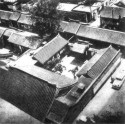
|
|
|
|
|

|

|
|
Renewal
Zhu
Zhong Chang, Beijing,
by Boulin Hu
|
Stadterneuerung
Zhu
Zhong Chang, Beijing, von
Boulin Hu
|
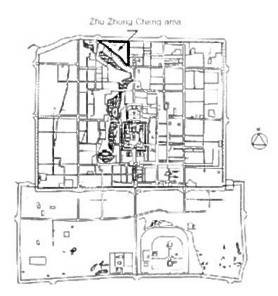
|
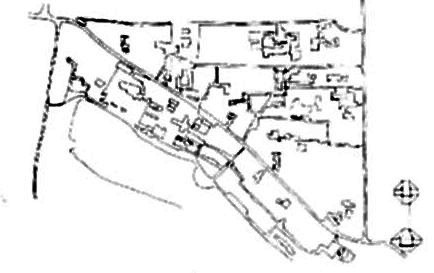
|
|
|
| Open Space & lane system |
Platz- und
Gassensystem |
|
|
Introduction
of the Projects
|
Einleitung
zu den Projektstudien
|
|
Zhu
Zhong Chang is an old area situates northerly of the Forbidden City
of Beijing and is necessary for renovation. The Architecture Faculty
of Tsinghua University Beijing, was authorized by the Municipal
Government of Beijing to set up a study of this area. In this
regard. our Master‑class took up the initiative on this
interesting project to cooperate with the Tsinghua University as a
matter of teaching exchange.
|
Zhu
Zhong Chang ist ein nördlich der Verbotenen Stadt gelegenes,
sanierungsbedürftiges Wohngebiet. Die Abteilung für Architektur
der TsinghLia Universität in Beijing wurde von der Regierung mit
einer Studie über die Erneuerung dieses Gebietes beauftragt. Es war
dies eine sehr interessante Aufgabe für die Studenten, die im
Rahmen eines Lehraustausches zwischen der Tsinghua Universität und
unserer Meisterklasse an diesem Projekt gearbeitet haben. |
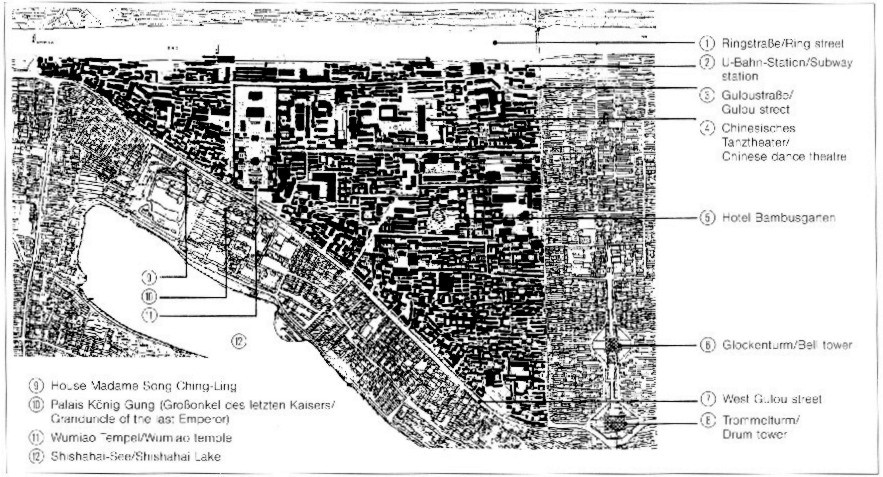 |
|
Zhu
Zhong Chang Area |
Zhu
Zhong Chang-Gebiet |
|
I.
Introduction and Comments on Students' Work |
I.
Einleitung und Kommentar zu den Studentenarbeiten
|
This
documentation consists groups of students of whose work lasted one
semester. Students come from 2nd year to 4th year and out of which
two had visited Beijing. (Most of the students who visited Beijing
in 1986 were graduates.) In the course of this study which could
not be undertaken by field-study, it could only be based on some
information materials supplied by the Tsinghua University and some
perceptual concepts on Beijing given by lectures. The financial
policy trend towards housing renewal in China is at the moment
still not clear, the outcome of this project, therefore, cannot be
sought. Because of time limited and incomprehensive understanding
of field‑study experience, students could only produce their
new ideas which would be based principally on the information
materials in hand.
There
are altogether nine groups of students. The content of group 1 to
group 7 consists the planning of site development and housing
structure whereas group 8 deals with only a part of housing
structure. Group 9 sketches three different projects from Chinese
schools which are planned on construction sites of certain housing
areas. These schools. though small, represent the traditional
Chinese school which simplification of Chinese wooden spatial
structure properly corresponds.
Nearly
all groups share the opinion of keeping a small part of the long existing
housing complexes which would be up kept and renovated to mark its
historical remains. In respect of the surrounding housing areas,
most of the groups emphasize the importance of the public
recreational areas around Shishahai Lake and the Wumiao Temple as
the heart of the whole district. Only two groups stress the
connection routes between the study area and the Bell-Drum-Tower
areas. (See groups 1 and 6)
In
the case of traffic planning, most of the groups emphasize on
pedestrian ways and ignore the tendency of heavy traffic which
accessibility (taxis and trucks) has to be considered. Group 3,
however, has drawn out flexible and parallel passages for
pedestrians and cars (trucks, fire brigades, ambulance services)
which could be accessible within 100 meters walking distance.
All
groups plan the factories at the edge of main streets whereas
shops either concentrate at city center or scatter apart Groups 4
and 5 arrange the shops at the slanting West Gulou street in order
to match the public activities at Shishahai Lake in future.
Concerning
the urban spatial determination, group 1 make a clear and rhythmic
orientation of directions. An accentuated entrance of Zhu Zhong
Chang area leading to the public buildings as well as to Ihe core
area has emphasized the effective combination with the Shishahai
Lake area. Group 7 combines the southern triangular green area
directly with the green zone at the Shishahai Lake is a remarkable
idea to be noted. In general, all groups contribute an averagely
high buildings in the North than in the South. It is somewhat
justified that !he southern establishment corresponds with the
retaining old area whereas the traffic noise could be guarded
against by higher complexes in the North. Group 1 and group 7
grasp the idea of planning multiple storey buildings at the Ring
street where the ancient city wall stood, simply for remembrance.
Making use of building constructions is not only a sort of mass
and form to symbolize its remembrance, but green parks, street
furniture, pattern of pavement and fanciful sculpture can be
indicated.
Regarding
to the structure of residential organization, most of them applies
the proto type of traditional lower courtyard houses. Nowadays,
though the Chinese traditional big family no longer practice. out
the living structure of small courtyard houses still contributes a
pleasant family atmosphere for more housing units; more plants can
be planted privately or publicly within the inner yards. (e. g.
group 1-C 1-Dand group 7.) The historical Viennese living
courtyard of public housing were once a marvelous example and most
of the students seize this good pattern for the structure of large
living courtyard. (e. g. Groups 1-E, 2, 4 and 5.) In Beijing,
there are large numbers of small and narrow lanes (hutongs) which
characterize the daily communal milieu outside the private
courtyards; such lane type of public spatial organization can be
conceived from groups 1-A, 3 and 6. It can be seen by group 3 that
a long courtyard which atmosphere portraits certain Similarity of
dead end (cul‑de‑sac) although the end of the street
ends up with a passage in the inner structure. Besides long
blocks, lanes style and living environmental concept of courtyard
houses, Group 2 applies the long and narrow housing form which is
similar to southern China streets design that each tiny house unit
consists of several penetrating small courts. The first room has
been designed as shop, the second and third room considered as
living and sleeping and the external roof-forms as well as the
garden wall have been planned like the joining of fish boats
parking one beside another. It's an interesting representation,
but would it be accepted by the Beijing citizens?
The
design of dwelling units consist of 35 M2, 50 M2 and 70 M2. Crowe
7 focus on skeleton construction by setting spontaneous concept of
flexible partition. The dwelling units of most projects
open up a corridor, each of them is a two-storey unit comprising
its independent staircase similar to maisonette style. For
example, two dwelling units are brought into three or four-storey
complex, the underneath dwelling unit occupies a small garden and
the upper one consists a balcony. This maisonette form of
construction is recently being often applied in Europe. It is a
noteworthy example.
To
formulate the traditional Chinese architectural language at this
modern era can hardly be interpreted by European students within a
semester's period. All participants have neither used the
traditional outer formulations of classical Chinese of
architectural elements nor the prevailing touristic Chinatown
portal, but instead, adapted to the socioeconomic human scale. The
housing designs of groups 1-A, 1-D and 8 share the similarity of
oriental wooden construction which combination of distinctiveness,
fineness and human interrelationship expressed.
Finally,
there are some observations regarding the housing relationship and
its identification. Besides by emphasizing the design quality of
public spatial plazas and public buildings in order to mark its
identification as a "place" for dwellers, it is
important that the entrances from housing groups and living units
should be distinctively and characteristically orientated. The
traditional Chinese community emphasizes much on the
identification of dwellers, hence much dead ends of
streets (dead Hutongs) and street gates are formed.
Concerning this point, some groups (1-C, 1-D, 1-E, 1-F, 2, 3 and
5) make their formulations by emphasizing the traditional image of
quarters' entrances with arcades and passages constructed over the
streets (corresponds to the Chinese city construction element
("Guo-jie-lou") (Groups 1, 3. 4 and 7) and gate
entrances to communal living courtyards. (Groups 1-C. 1-D, 1-E, 1-F,
2, 3 and 5.)
It
is a stimulating and cultivate subject to coalesce the naturalism,
territorialism and ethicism of the traditional Chinese specified
construction with the Western technique conformed with modern
human ideas. Further more, in achieving the renewal of Zhu Zhong
Chang area, it is recommended to establish a program for
participation on construction through the dwellers.
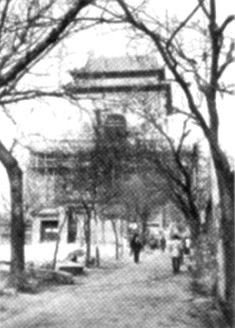 |
 |
| Bell Tower |
Glockenturm |
Drum Tower |
Trommelturm |
|
Diese
Dokumentation entstand in einsemestriger Arbeit durch mehrere
Studentengruppen. Die Studenten kamen aus dem zweiten bis vierten
Studienjahr, zwei davon waren in Beijing (die Studenten der
Studienreise nach China im Jahr 1986 waren meistens Diplomanten).
Da eine Feldstudie nicht möglich war, arbeiteten die Studenten
auf Grund der von der Tsinghua Universität bereitgestellten
Materialien und den Erlebnisberichten der Betreuer. Auch wurden
Probleme bei der Realisierung bzw. deren Finanzplanung nicht
behandelt, weil die dazu nötige Information über die derzeitige
öffentliche Finanzpolitik fehlte, Bedingt durch diese Einschränkungen
konnten bei den vorliegenden Aufgaben hauptsächlich
Erneuerungsideen als Übung für die Studenten ausgearbeitet
werden.
Die
Studentenarbeiten verteilen sich in neun Gruppen. Der Inhalt von
Gruppe 1 bis Gruppe 7 enthält die städtebauliche Struktur des
Gesamigebietes und die Wohnstruktur. Gruppe 8 behandelt nureinen
Teilbereich der Wohnstruktur. Gruppe 9 zeigt drei verschiedene
Projekte von chinesischen Schulen, welche auf einem angenommenen
Baugrund eines Wohngebietes geplant wurden, zwar sehr klein, doch
ging es vorwiegend darum, den regionalen Charakter und die
raumliche Organisation der traditionellen chinesischen Schule
durch Vereinfachung der chinesischen Holzkonstruktion
widerzuspiegeln.
Fast
alle Gruppen sind der Meinung, einen kleinen Bereich des
existierenden Wohngebietes zu erhalten bzw. zu sanieren, um die
historischen Spuren der Entwicklung beizubehalten. Was die
Beziehung zu den umliegenden Gebieten betrifft, betrachten die
meisten Gruppen die offentlichen Aktivitäten um den Shishahai-See
als wichtigsten Punkt und den Wumiao-Tempel als das eigentliche
Herz des Gesamtgebietes. Zwei Gruppen betonen die Verbindungswege
zwischen dem Studiengebiet und dem Glocken-Trommel-Turm-Gebiet (Gruppe
1, 6).
Die
Verkehrsorganisation der meisten Arbeiten ist stark auf die Fußgängerwege
konzentriert, die Tendenzen einerZunahme des Autoverkehrs (unter
anderem Taxi und kleine Lieferwagen) und dessen Erreichbarkeit
bleiben weitgehend unberücksichtigt. Die Gruppe 3 jedoch hat ein
System von abwechselnden, parallelen Wegenetzen für Fußgänger
und Autos (Lieferwagen, Feuerwehr, Notfalldienst etc.), die
innerhalb von 100 m Gehentfernung erreichbar sind, entworfen.
Alle
Gruppen disponieren die kleinen Fabriken an den Rand der Hauptstraßen;
die Geschäfte entweder in das Zentrum oder in die Teilgebiete.
Die
Gruppen 4 und 5 verlegen die Geschäfte entlang der schrägen Straße
(Gulou West Street), uni sie in die Aktivitäten um den Shishahai-See
zu integrieren.
In
bezug auf die städtebauliche Baumassenverteilung bietet die
Gruppe 1 eine klare Raumfolge und übersichtliche Ortsbezüge. Ein
betonter Eingang des Zhu Zhong Chang‑Gebietes, der in das
Gebietszentrum bzw. zu den öffentlichen Gebäuden führt, wird
mit dem Shishahai-See-Areal in eine stark akzentuierte Verbindung
gesetzt.
Die
Gruppe 7 reserviert eine konzentrierte Freifläche im Süden,
damit eine unmittelbare Grünzone an das Shishahai-Areal anschließt,
was als bemerkenswerte Idee gewertet werden kann. Im allgemeinen
ordnen alle Gruppen im Zuge der Baumassenverteilung die Gebäude
im Norden höher und im Süden niedriger. Es ist gerechtfertigt,
daß die Baumasse im Süden dem alten Bestand angepaßt wird, während
im Norden die höhere Bauweise das Quartier vor dem Verkehrslärm
der Ringstraße schützt.
Die
Gruppen 1 und 7 hatten die Idee, mit der Planung mehrgeschossiger
Gebäude an der Ringstraße an den Standort der früheren
Stadtmauer zu erinnern. Dies ist an sich sicher nicht die einzige
Möglichkeit, durch Baumasse das Image der Stadtmauer auszudrücken.
Durch Gestaltung des Bodenbelages, Skulpturen oder Straßenmöblierung
könnten interessante Aspekte gesetzt werden.
Für
die Organisation der Wohnstruktur werden von allen Gruppen die
traditionell niedrigen Wohnhofbauten angewandt. Wenn auch in der
neuen chinesischen Gesellschaft das Leben in der Großfamilie
vielfach nicht mehr praktiziert wird, kann die Wohnstruktur des
Wohnhofes noch immer angenehme öffentliche Räume für mehrere
Familien bieten. Der Innenhof kann sowohl öffentlich als auch
privat bepflanzt werden (z. B. Gruppe 1-C, 1-D und Gruppe 7). Daß
die Wohnhöfe der geschichtlichen Wiener Wohnblockbauten eine
angesehene Vergangenheit haben, nehmen die Studenten als gutes
Beispiel für die Struktur der großen Wohnhöfe (z. B. Gruppe 1-E,
Gruppe 2, 4, 5). In Beijing gibt es viele kleine enge Gassen, die
"Hutongs". Sie stellen den täglichen Lebensraum außerhalb
der privaten Wohnhöfe dar. Bei den Projekten 1-A, 3 und 6 wird
die gassenartige Wohnstruktur sichtbar. Darunter sehen die Gassen
im Projekt 3 wie lange Wohnhöfe aus und haben eine gewisse Ähnlichkeit
mit einer Sackgasse einer Hausgruppe der "Cluster"-Bauweise,
obwohl am Ende der Gasse ein Durchgang im Hausblock besteht. Außer
der Wohnstruktur von Hofform, Zei
lenblock
und Gassenform benützt die Gruppe 2 noch die Langschmal-Wohnform
von südchinesischen Straßenwohnbauten, d.h., jede schmale
Hauseinheit enthalt mehrere kleine Höfe in dieTiefe. Der erste
Raum wird als Geschäft, der zweite und dritte als Wohn- und
Schlafzimmer geplant, die äußeren Dachformen und Gartenmauern
sind vom Entwerfer wie nebeneinanderstehende Fischerboote
gestaltet. Eine interessante Darstellung, offen bleibt jedoch die
Akzeptierbarkeit durch die Beijinger Einwohner.
Die
Nutzfläche der Wohnungsgrundrisse reicht von 35m2 über 50 m2 bis
zu 70 M2.
Die Gruppe 7 verwendet in allen Geschossen die Skelettbauweise, um
die flexible Organisation des Grundrisses zu ermöglichen. Die
Wohneinheiten der meisten Projekte werden durch einen Laubengang
erschlossen, einzelne sind in Annäherung an Maisonetten-Wohnungen
geplant, d. h., zwei Wohneinheiten sind in drei oder vier Geschoßeinheiten
untergebracht, das öffentliche Stiegenhaus wird erspart, die
untere Wohneinheit besitzt einen kleinen Vorgarten, die obere
einen kleinen Balkon. Durch einen direkten Zugang zu jeder
Wohneinheit im Erdgeschoß wird die Erschließung zum oberen
Geschoß durch einen Laubengang erreicht. Diese Maisonettenform,
die in jüngerer Zeit in Europa viel angewendet wird, ist ein
beachtenswertes Beispiel.
Die
chinesische traditionelle Formensprache in das Moderne zu
transformieren, stellt eine kaum zu bewältigende Aufgabe für
europäische Studenten im Zeitraum eines Semesters dar. Alle
Beteiligten haben eine Kopie der traditionellen Bauformen
vermieden und versuchten auch nicht, eine touristische Chinatown-Szene
zu entwerfen. Es wurde durchwegs versucht, einer humanen Maßstäblichkeit
gerecht zu werden. In den Projekten 1-A, 1-D und 8 kommt die
Atmosphäre der östlichen Holzbaukonstruktion durch Kombination
von Klarheit, Feinheit und menschengerechter Maßstäblichkeit zum
Ausdruck.
Zuletzt
noch einige Betrachtungen über den Ausdruck der Identifikation
und der Ortsverbundenheit. Es ist wichtig, das ein ortsgebundener
Identifikationsausdruck in der Art und Qualität der Gestaltung
von öffentlichen Plätzen und öffentlichen Gebäuden ebenso wie
bei den Eingängen von Wohnungsgruppen und Wohneinheiten zum
Tragen kommt. Die chinesischen traditionellen Wohngebiete achteten
sehr auf die Identifikationsgefühle ihrer Bewohner. Es gab daher
in den alten Gebieten viele Sackgassen, "tote Hutong",
und viele Gassentore mit identifizierbaren Namen. Unter diesem
Gesichtspunkt wurden von einigen Gruppen Überlegungen eingebracht
(z. B. Gruppe 1, 3, 4, 7) um das traditionelle Image des
Quartiereinganges mit Toren und durchgangartigen Überbauungen über
den Straßen (entspricht dem chinesischen städtebaulichen Element
"Guo-jie-lou") oder mit gestalteten Durchgängen der
Wohnhöfe auszudrücken.
Die
vorliegenden Arbeiten brachten uns gute Erfahrungen im Sinne des
kulturellen Austausches von Ost und West. Eine Annäherung
zwischen der chinesischen traditionellen Anschauung von
Naturharmonie, Bereichsidentifikation und ethischer Ordnung
einerseits und der europäischen modernen Technologien und
Philosophie der Humanität andererseits bleibt ein interessantes
Thema. Ferner, für die Realisierung der Erneuerung des Zhu Zhong
Chang-Gebietes, ist ein Bauverfahren zu empfehlen, daß die
Selbsthilfe der Bewohner miteinbezieht.
|
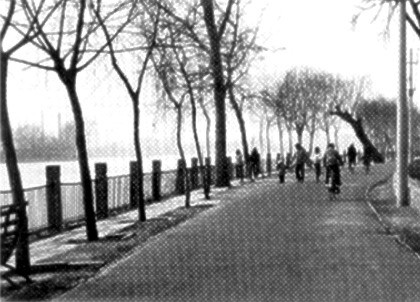 |
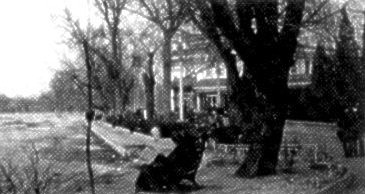 |
|
| Street along the Shishahai-Lake |
Straße
entlang Shishahai-See |
Shishahai-Lake |
Shishahai-See |
West Gulou
street |
|
|
lI.
Existing
Situation |
II.
Ist-Zustand des Studiengebietes
|
1.
Location
This
study area situates at the northern side of the Forbidden City,
Beijing, west of the Gulou Street and north of Shishahai Lake. The
slanting edge of the West Gulou Street forms the triangular area
with about 1,200 m length, 900 m width and with a total area of
53.74 hectare. North of this area had once been the Beijing's
farthest moat and the former old city wall; it is now being
planned for efficient Second Ring Street with underground railways
beneath for public transportation, and stations established at the
crossing between Second Ring street and Gulou street. Gulou
street, Shishahai Lake and Curve street have always been a busy
commercial area. Shishahai Lake becomes a recreational center for
Beijing citizen; amusement such as boa, rowing, tea party,
gymnastic, enjoy birds singing, promenade etc. North of Shishahai
Lake is the grand uncle's house of the last Emperor (now is the
Ministry of Health) and former residence of Madam Sung Tsing Ling;
it will probably be opened for exhibition.
2.
Space Framework
Municipal
City Planning Bureau has shortly authorized the Tsinghua
University to propose an entire restoration plan on Shishahai Lake
and Bell-Drum-Tower areas, The Massachusetts Institute of
Architecture and Tsinghua University exchange research program
have in this respect drawn up a concept of urban space framework,
reviewing the close relationship between Zhu Zhong Chang and Bell-Drum-Tower
areas. Our study program refers most of their concept.
3.
Circulation
Gulou
street is the only main street which has the close connection with
the north. A construction site north of Ring street which is
considered for expansion, will be eventually planned for the
future Olympic stadium. Thereafter, traffic to the north (to Great
Wall, Ming Tomb) can be expedited through Ring street and the
traffic at West Gulou street could be henceforth loosened. The
Ring street is an efficient route under which railways runs and
stations situate at east and west: moreover, public buses can
still be run along the West Gulou street. Besides the vertical and
horizontal passages of 5 to 8 m which can be used for automobiles,
there are also Hutongs of 3 m inter-crossing one another, thus, is
a good example of preventing the disturbance from traffic.
4.
Land Use and Public Buildings
It
has been planned by the Urban Design Bureau that 30‑50 m width
region will be reserved for green zones along the southern side of
the Ring street (north of Bell‑Drum‑Tower areas are also
designed for green zones). Although the lake area which is south of
the West Gulou street is not included in the planning areas, but
most of the buildings there will be demolished or destroyed in order
to establish green zones along the lake areas except some
historically significant structures and sites or communal housing
units of worthy preservation.
Besides
a small number of Hutungs among the communal buildings which are
worthy to preserved, the rest will be entirely demolished. Wumiao
and Bamboo Garden Hotel will be retained, governmental units and new
buildings of 4 to 6 storeys should be as well maintained. The
orientation of schools can be altered or removed and more parks as
well as recreational areas should be constructed within the city.
The present Wumiao area is the religious Lama's representational
Bureau in Beijing and is not opened for public; its area plays an
historical and traditional role amongst the citizens and should be
re-opened again.
5.
Living Conditions
Zhu
Zhong Chang area situates at the north of City Beijing. It has not
been developed in the past as a commercial center, but has peen
mainly used for habitation. There are a large number of governmental
units and domiciliaries of factory workers. The housing propriety is
seldom privately-owned and land is state monopoly. The housing units
in City Beijing have always been inadequate though big family
composition has not been vital; thus several families would group
themselves in one communal unit thereby forming illegal temporary
and additional constructions with odds and ends piling up cooking,
washing utensils which became a so called "clutter court".
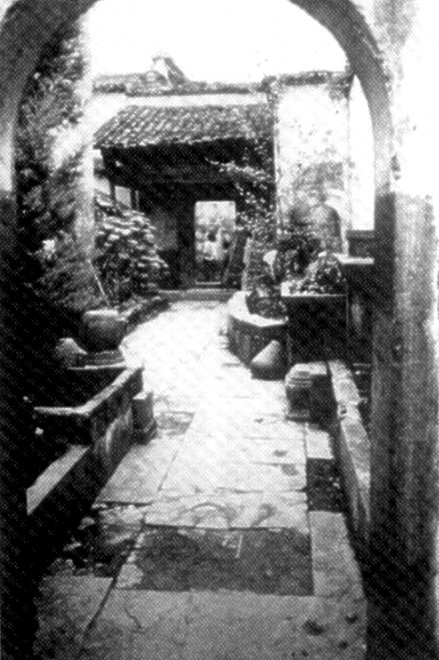 |
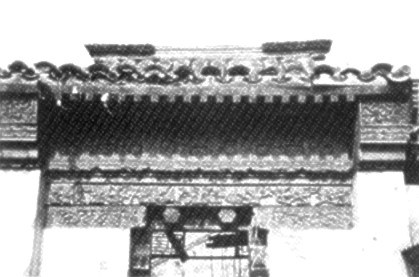 |
| The Lane |
Gasse |
Entrance of a courtyard house |
Eingang eines
Hofhauses |
|
1.
Lage
Das
Zhu Zhong Chang-Gebiet liegt nördlich des Shishathai‑Sees
und der Verbotenen Stadt, schließt im Westen an die schräge West-Gulou-Straße
und im Osten an die Gulou-Strae an. Die rechtwinkelige Seite
beträgt ca. 1.200 m, die kurze Seite ca. 900 m. Das gesamte
Gebiet umfaßt eine Fläche von 53,74 ha.
Die
langgestreckte nördliche Seite, wo früher Stadtgraben und
Stadtmauer verliefen, wurde als die zweite tangentiale Ringstraße
der Stadt und für die Untergrundbahn geplant. Es gibt eine U-Bahn-Station
an der Kreuzung der Gulou-Straße und Ringstraße. Die Umgebung
von Gulou-Straße, Shishahai-See und Wan street (Kurvenstraße)
gilt als lebendige Geschäftszone. Die Gegend um den Shishahai-See
stellt eine der wichtigsten Freizeit- und Erholungszentren
Beijings dar. Bekannt sind unter anderem die Teehäuser,
Sportanlagen, Bootsvermietungsstellen und die schönen Parks, in
denen Vogelsingwettbewerbe stattfinden. Dort befindet sich auch
das Palais vom Großonkel des letzten Kaisers, das jetzige
Gesundheitsministerium, und das Wohnhaus der ehemaligen
Ehrenvorsitzenden Madame Song Qing-Ling, am nördlichen Ufer des
Shisha-Sees gelegen. Die beiden Gebäude werden in Zukunft als
Museen zu besichtigen sein.
2.
Städtebaulicher Zusammenhang
Das
Beijinger Stadtplanungsamt beauftragte die Tsinghua Universität
mit der Umgestaltung des Shishahai- und des Glocken-Trommel-Turm-Gebietes.
Das amerikanische MIT-Institut hat im Rahmen eines
Forschungsaustausches in Zusammenarbeit mit der Tsinghua Universität
einen Vorschlag ausgearbeitet, der den engen Zusammenhang des Zhu
Zhong Chang zu dem des Glocken-Trommel-Turm-Gebietes hervorhebt.
Wir versuchen mit unseren Studien ebenfalls diese städtebaulichen
Zusammenhänge wahrzunehmen.
3.
Verkehrssituation
Die
Gulou-Straße wird verbreitert und als Hauptverbindungsstraße zum
Areal im Norden für die vorgesehenen olympischen Spiele geplant.
Durch sie und die zweite Ringstraße soll der Verkehr Richtung
Norden zur großen Mauer und den Ming-Grabern geführt und die
Schragstraße (West-Golou-Straße) entlastet werden. Die Ringstraße
ist eine Express-Straße, unter der die U-Bahn-Linie verläuft. An
den beiden Enden der Ringstraße nördlich des Zhu Zhong Chang-Gebietes
gibt es zwei U-Bahn-Stationen. Auf ders chrägen Straße verkehren
öffentliche Busse. Das Wegenetz im Zhu Zhong Chang-Gebiet besteht
vorwiegend aus zickzackartigen engen Gassen, die nur für Fußgänger
und Fahrräder bestimmt sind. Für den motorisierten Verkehr gibt
es einige Wege von 5 bis 8 m Breite. Diese Gegebenheiten gewährleisten
fur das Wohngebiet optimalen Schutz vor Verkehrslärm.
4.
Flächennutzung und Bauten
Entlang
der Ringstraße wird ein 30 bis 50 m breiter Grünstreifen als
öffentliches Erholungsgebiet geplant. Auch nördlich des Glocken-Trommel-Turm-Gebietes
ist ein zusammenhängender Grünstreifen vorhanden. Das kleine,
streifenförmige Areal zwischen der \/Vest-Gulou-Straße und dem
Houhai-See fällt nicht in unser Studiengebiet. Diese Fläche ist
von den Behörden als Erholungsgebiet vorgesehen, auf dem nur die
wichtigsten historischen Bauten erhalten bleiben. Die im
Studiengebiet gelegenen, in den fünfziger Jahren schlecht gebauten
Hofhäuser
befinden sich in sanierungsbedürftigem Zustand. Nur wenige sind
erhaltenswert. Als geschützte Bauten gelten ein Tempel (Wumiao) und
das Hotel "Bambusgarten". Der Wumiao-Tempel ist zur Zeit
Sitz des Tibetanischen Vertretungsamtes und öffentlich unzugänglich.
Der Tempel mit seinem Platz war in der Vergangenheit Zentrum des
alltäglichen Lebens, es ist zu hoffen, daß er dies auch in Zukunft
wieder wird. Einige vier- bis sechsstöckige Hochhäuser und
Institutionen sind beizubehalten, Industrien und Schulen können
umgelegt werden. Im dichtbebauten Flachbaugebiet besteht Mangel
an freien öffentlichen Plätzen und Kinderparks.
5.
Wohnsituation
Obwohl
des Zhu Zhong Chang-Gebiet nördlich der Verbotenen Stadt liegt, hat
sich daraus nie eine kommerzielle Zone entwickelt. Es identifiziert
sich hauptsächlich als Wohngebiet von Angestellten und Arbeitern
der Institutionen und Fabriken der Umgebung. Die Häuser und Grundstücke
sind selten Privatbesitz. Es besteht ein großer Mangel an Wohnungen
in beijing Heute existieren die Großfamilienstrukturen nicht mehr.
Es leben daher oft viele Familien beengt in einem ehemals schönen
und großzügigen Hofhaus. Um der Enge entgegenzuwirken, wurden
provisorische Anbauten in den Hof gemacht und die Kochstelle dorthin
verlegt, daher die heute übliche Bezeichnung: "Hof des großen
Wirrwarr".
|
 |
 |
 |
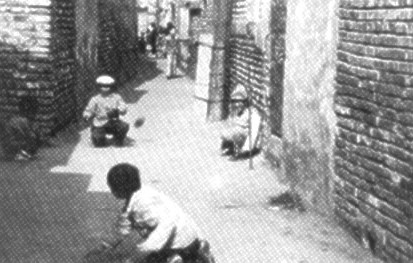
| The Lane |
Gasse |
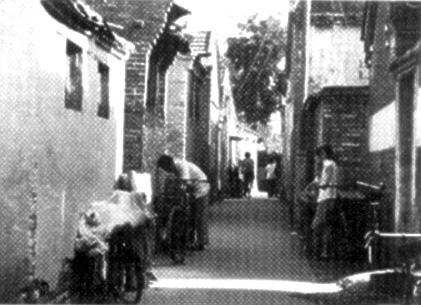
Narrow lane |
Die schmale
Gasse |
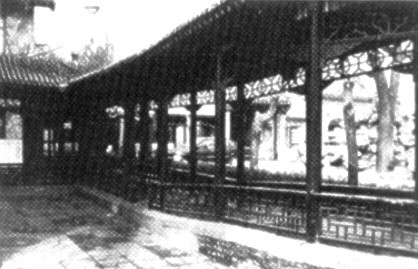
Bambogarden Hotel |
Hotel
Bambusgarten |
|
|
Ill.
The
Program of the Planning Area |
III.
Das Planungsprogramm |
|
The
Tsinghua University has recently proposed an assessment of
livability for this area: the residential density would be for small
and medium degree and neighborhood net density would be 500-600
inhabitants per hectare, in other words floor area ratio would re
approx. 1.0. The average building area would be 18-20 m2 per
inhabitant with a minimum criteria of floor area of 10 m2
per inhabitant whereby each family unit would have approx. 3.5
inhabitants. Under the control of such living density, the housing
open area would be 50%-65%, hence the average storey would be
approx. 3 levels. With the retaining governmental units and public
facilities, the remaining net living area would be 50%, i.e. approx.
26 hectares. The estimation of inhabitants would be 10,300 out of
which 3,000-4,000 family units are included. |
Die
Fakultät für Architektur an der Tsinghua Universität hat für
dieses
Planungsgebiet
eine Nettowohndichte von 500 bis 600 EVV/ha bzw.
eine Bebauungsdichte von 9.000 bis 10.000 m2/ha (d. h. Geschoßflächenzahl
GFZ 1,0) vorgeschlagen. Daraus wurde der Bedarf des
Nettowohnbaulandes mit 18 bis 20 M2/EW ermittelt. Laut den
Bestimmungen der Beijing Behörden für den Gebäudeabsland im Verhältnis
1 :1,6 ergibt sich die Grundflächenzahl GRZ von etwa 0,5 bis 0,35. Die
Geschoßanzahl ergibt sich auf Grund der GFZ und der GRZ mit
durchschnittlich drei Geschossen. Die zahlreichen Institutionen,
Fabriken und öffentlichen Bauten und die noch auszubauende
Infrastruktur
beanspruchen etwa die Hälfte der Fläche des Planungsgebietes. Die
fur das Wohnen verfügbare Fläche beträgt noch ca. 26 ha. Die
Einwohnerzahl kann mit mindestens 10.300 (etwa 3.000 bis 4.000
Haushalte) angenommen
werden.
|
|
IV.
The
Criteria of Concept Development |
IV.
Planungskriterien |
|
A
determination on the present Chinese housing prospect has been
pinpointed. Underneath is a check‑list of the main functional
aims and behavioral criteria laid down by me which objectives
students will individually establish their own master plans and
principles accordingly. This check-list is for the purpose to
assist students in creating a general and perceptual concept towards
this study plan. Owing to time limitation, the consideration in
every aspect of this composition cannot be fulfilled.
Planning
Goals:
-
To
redevelop Zhu Zhong Chang area as an demonstrative example of
renewal project of a harmonious community both for living and
working as well as to raise the quality of modern living
conditions.
-
To
integrate and benefit the facilities of recreational use on the
bordering zone of Zhu Zhong Chang area with Shishahai Lake area.
-
To
plan an attractive transit path between the subway station to
the north and the Shishahai Lake to the south,
-
To
vitalize the surrounding area of Wumiao Temple as a center of
traditional activities within the district.
-
To
plan accessible public and private open space for creating the
communal atmosphere of daily life.
Criteria
of Planning Framework:
A.
Objectives and Considerations
-
Sense
of region.
-
Image
of district or unique character.
-
Tracers
of different changing phases of the development.
-
Remaining
original urban grain.
-
Adaptability
with surrounding area.
B.
New Function of the Location
-
City
wide function.
-
Local
function.
-
Higher
valuation through planning and renewal.
-
Higher
housing condition.
-
Regulated
circulation.
-
Historical
meaning of conservated Buildings.
-
Raising
the living quality of surrounding area.
-
Priority
on renewal section.
C.
Housing and Public Use
-
Diverse
densities and sizes of dwelling units.
-
Diverse
prototypes of housing.
-
Grouping
of housing units.
-
Combination
with administration and cultural activities.
-
Distribution
with schools and kindergartens within short walking distance and
combination with sport and cultural activities for communal
use in the evening.
D.
Commercial
-
Offices,
hotels with public use at the first level.
-
Institutions
combine with public services.
-
Centralize
department stores and also serve neighboring districts.
-
Shops
along streets and commercial activities at subway station.
-
Distribution
of small professional workshops and factories without pollution.
-
Convenient
groceries for daily needs at street corners near housing groups.
-
Bazaar
streets and food stands.
-
Market
places.
E.
Open Space and Recreation
-
Accessibilities.
-
Public
facilities and street furniture
-
Combination
with local sport lots and children playgrounds in Housing
group.
-
Balancing
distribution of small open spaces.
F.
Transportation and Circulation
-
Transit
area of subway, buses and bikes.
-
Classification
of automobile traffic, and priority of pedestrian/bike paths.
-
Walking
distance to public transportation.
-
Access
to emergency and loading.
-
Parking
concept and bike racks.
-
Prevention
of through traffic within the residential area.
G.
Building Height
-
Distribution
of building height.
-
Adaptability
to surrounding districts.
-
Protection
against noise and wind.
-
Human
scale.
-
Elevated
complex for good view and observatory.
H.
Formation of Urban Space
-
Space
sequence of urban network.
-
Visual
corridors between important utilities and nature.
-
Focus
points and representative buildings.
-
Variety
and contrast between public buildings and other buildings.
-
Landscape
concept for large scale green area.
-
Streetscape:
harmonious unity, setbacks, Facade rhythm, pavement and trees
etc.
-
Views
to historical buildings
and nature outside the planning area.
-
Traditional
image of space form.
I.
Orientation and Identification
-
Promenade
paths or primary connections with surrounding area by means
of clear direction and perceptual experience.
-
Rhythm
of paths and small space nodes giving serial vision.
-
Identifiable
main entrance of district with community name.
-
Identifiable
small domains of housing groups but not being isolated.
-
Distinguished
character of major paths.
-
Public
open space and individual open space for dwelling units.
-
Symbolic
elements and naming system of streets and paths.
J.
Communication
-
Community
sense through organized activities and spaces.
-
Narrow
lanes and defined open spaces in housing groups.
-
Sense
of places for all walks of life and societies.
-
Communicating
signs and information corner in public urban spaces.
-
Shelters
and shady space for public communication.
-
Communal
life of housing groups through effective arrangement of
circulation and common places.
K.
Qualities of Housing
-
Improvement
of housing conditions such as sanitary, insulation and hygiene.
-
Natural
regulation of lighting and climate condition.
-
Possibilities
for individual design by dwellers.
-
Shared
common open spaces and individual small garden, terraces or
large balconies.
-
Flexibility
and privacy of partition in dwelling unit.
-
Simple
and economical construction with good quality.
-
Various
dwelling units for individual needs and participating design.
-
Human
scale and vitality of living environment.
-
Useful
common places or rooms for storage, newspaper reading, exercise,
hobby workshop and clothes drying etc. in housing group.
-
Traditional
continuity of architectural form expression.
-
Space
for ceremony of ancestor altar in dwelling unit.
-
Place
at entrance for hanging of good fortune calligraphy during Chinese
new year.
Boulin
Hu
|
In
vergleichender Betrachtung und Diskussion der Wohnsituation in
Europa und China wurden von mir Aufgabe, Zielsetzung und Kriterien
zum Planungsinhalt erstellt. Auf Grund derselben konnten die
Arbeitsgruppen ein eigenes Planungskonzept erarbeiten.
Zielsetzungen
-
Das
Zhu Zhong Chang Gebiet als demonstratives
Stadterneuerungsbeispiel, mit harmonischem Nebeneinander von
Wohnen und Arbeiten, den Anforderungen moderner Wohnbedürfnisse
und Lebensqualilät entsprechend zu gestalten.
-
In
die der Erholung dienenden Nutzungen und Einrichtungen im
Grenzbereich des Zhu Zhong Chang-Gebietes das Shishahai-SeeGebiet
zu integrieren, um vom Erholungswert des Wassers zu profit i
eren.
-
Einen
attraktiven Verbindungsweg zwischen der U-Bahn im Norden und dem
Shishahai-See im Süden zu schaffen.
-
Den
Wumiao-Tempelbereich als Zentrum der traditionellen
nachbarschaftlichen Aktivitäten zu revitalisieren.
-
Durch
öffentlich und privat zugängliche Freilufträume eine (angenehme)
Wohnatmosphäre zu schaffen.
Planungskriterien
Zhu Zhong Chang
A.
Überlegung der Planungsprinzipien
-
Empfindung
zur Ortszugehörigkeit.
-
Identifizierbares
Ortsbild.
-
Zeitliche
Veränderungen des städtebaulichen Gebildes sichtbar machen.
-
Erhaltung
der ursprünglichen städtebaulichen Struktur.
-
Anpassung
an die Bereiche der Umgebung.
B.
Neue Funktion und Bedeutung der Lokalität
-
Überörtliche
Bedeutung.
-
Örtliche
Funktion.
-
Erhöhter
Wohnwert durch Umplanung und Renovation.
-
Bessere
Wohnbedingungen.
-
Geregelte
Verkehrsorganisation.
-
Historische
Bedeutung der zu erhaltenden Gebäude.
-
Erhöhung
der Wohnqualität der Umgebung.
-
Priorität
der zu erneuernden Abschnitte.
C.
Das Wohnen und öffentliche Nutzungen
-
Diverse
Wohndichte und Größenvariante der Wohneinheiten.
-
Festlegung
der Prolotypen für die Wohnstruktur.
-
Gruppierung
der Wohneinheiten.
-
Kombination
von Administration und kulturellen Aktivitäten.
-
Einzugsbereich
von Schulen und Kindergarten in Kombination mit Sport und
kulturellen Aktivitäten. Optimale Ausnutzung tagsüber und
abends.
D.
Geschäfte und Betriebe
-
Hotel-
und Bürobetriebe mit öffentlicher Nutzung im Erdgeschoß.
-
Institutionen
kombiniert mit Dienstleistungen.
-
Zentral
gelegene Geschäftszone für das Zhu Zhong Chang-Gebiet und auch
für die Nachbarschaft.
-
Geschäfte
entlang der wichtigen Straßen, und Geschäfte im Bereich der U-Bahn-Station.
-
Betriebe
und Fabriken so anordnen, daß eine Umweltbelastung vermieden
wird.
-
Leicht
erreichbare Lebensmittelgeschäfte an den Straßenecken im
Wohnbereich.
-
Basarstraßen
und Speisenstände im Freien.
-
Marktplätze.
E.
Erholungs- und öffentliche Plätze
-
Erreichbarkeit
und Zugänglichkeit.
-
Öffentliche
Einrichtungen und vielfältige Straßenmöblierung.
-
Kombination
von lokalen Sportplätzen und Kinderspielplätzen im Bereich der
Wohngruppen.
-
Angemessene
Verteilung der kleinen öffentlichen Plätze.
F.
Transport und Verkehrsorganisation
-
Umsteigeplätze
für U-Bahn, Autobusse und Fahrräder.
-
Klassifikation
des PKW-Verkehrs, Priorität des Fußgängerverkehrs bzw. der
Fahrradwege.
-
Optimale
Weglänge für Fußgänger zu den öffentlichen Verkehrs itte
In.
-
Zugänglichkeit
für Anlieferung und Notfalldienst.
-
Konzepte
für Parkplätze und Fahrradabstellplätze.
-
Vermeidung
von Durchgangsverkehr innerhallb des Wohngelbietes.
G.
Gebäudehöhe
-
Verteilung
von Baumasse und Gebäudehöhe.
-
Anpassung
an den umliegenden Bereich.
-
Schutz
vor Lärmemissionen und Wind.
-
Menschengerechter
Maßstab.
-
Aussichtstürme.
H.
Gestalt der öffentlichen Plätze
-
Raumfolgen
in der städtelbaulichen Struktur.
-
Visuelle
Bezüge zwischen wichtigen Einrichtungen und dem Grün der Natur.
-
Brennpunkte
und repräsentative Bauten.
-
Unterscheidung
und Kontrast zwischen öffentlichen und privaten Bauten.
-
Landschaftsgestaltungskonzept
für großräumige Grünflächen.
-
Gestaltungder
Straßenräume: Fassadenrhythmus, Fassadenrücksprünge, Straßenbeläge,
Bepflanzung etc.
-
Aussichtsbezüge
zu historischen Bauten und der Natur außerhalb des Gebietes.
-
Traditionelle
Identität der öffentlichen Raumform.
I. Bewegungstendenz des Stadtraumes und Identifikation
-
Klare,
richtungsorientierte und erlebnisreiche Promenaden- oder
Hauptverbindungswege mit der Nachbarschaft.
-
Rhythmus
und Reihenbildung der Wege und Wegknoten.
-
Erkennbare
Haupteingänge der Stadtteile durch Tore mit Namen oder anderen
Gestaltungselementen.
-
Identifizierbare
kleine Wohngruppenbereiche und Vermeidung von Isolierung.
-
Unterschiede
im Charakter der Hauptwege.
-
Öffentliche
und individuelle Freilufträume für die Wohneinheiten.
-
Symbolische
Deutung der Stadtmöblierungselemente und Straßennamen.
J.
Kommunikation
-
Empfindung
der Gebietszugehörigkeit durch organisierte Aktivitätsräume.
-
Schmale
Gassen und raumabschließende öffentliche Plätze innerhalb der
Wohngruppen.
-
Ortsidentität
und Zugehörigkeitsgefühl für diverse Berufs- und
Altersgruppen und Vereine aller Stufen.
-
Kommunizierbare
Zeichen und Stadtinformationsstellen im öffentlichen Stadtraum.
-
Vordächer,
Pergolen und schattige Plätze für die öffentliche
Kommunikation.
-
Kommunales
Leben in Wohnungsgruppen durch effektive Zuordnung der Verkehrs-
und Aufenthaltsräume bzw. -platze.
K.
Wohnqualität
-
Verbesserung
der Wohnbedingungen insbesondere in den Bereichen Bauphysik,
Sanitär und Hygiene.
-
Natürliche
Belichtung und Klimakontrolle.
-
Möglichkeiten
für individuelle Gestaltung durch die Bewohner.
-
Öffentliche
Plätze für gemeinsame Nutzung und kleine, private Gärten,
Terrassen oder große Balkone.
-
Flexible,
Privatheit gewährleistende Trennwandsysteme in den
Wohneinheiten.
-
Einfache
und wirtschaftliche Konstruktion mit guter Qualität.
-
Variable
Wohneinheiten für individuelle Bedürfnisse und Teilnahmemöglichkeit
am Planungsvorgang.
-
Menschengerechte
Maßstäblichkeit und lebendiges Wohnumfeld.
-
Gemeinschaftsräume
oder Plätze für Sport und Freizeitgestaltung sowie Abstellplätze
und Trockenräume bzw. -platze,
-
Beibehaltung
bzw. Schaffung der traditionellen Kontinuität im
architektonischen Formausdruck.
-
Platz
für die Zeremonien und um den Ahnenaltar in den Wohnungen.
-
Möglichkeiten
im Eingangsbereich zum Aufhängen der glücksverheißenden
Spruchbänder.
Boulin
Hu
|
|
|
|

胡寶林
鑄鐘廠地區更新研究
鑄鐘廠地區位於北京舊城的北端,什剎海地區北面。北京清華大學建築糸接受市政府之委託,研究該區今後的城市更新計劃。本研究以此一案例為對象,與清華大學進行學術交流。
一
前言及短評
本規劃資料是一份包括多個學生小組的學期作業,設計工作歷時一學期。參加規劃的有大學二年級至四年級的學生,其中兩位到過北京(1986年之前,曾去過北京參觀的多為當時的畢業生)
。本作業因無法作實地調查,只憑清華大學提供的照片,現狀圖紙及規劃要求等資料和指導教師對北京的體驗和印象,做為學生研習本案之起點。關於該區的閞發順序和投資問題,由於對目前中國經濟結構及發展趨勢不詳,無法深入探討。因此本研習只能在有限的時間內和對問題認識的一定深度下進行,擬出並提供一些原則性之規劃與設計構想。
學生作品共分九組,第1組至第7組,作業包括社區結構和住宅單元組織兩個方面。第8組僅有住宅單元的組織。第9組則為學校建築設計,共三個方案,內容為一規模甚小的校舍設計,假想建於住宅區內某一校舍基地上。作品試圖表達一種具有中國傳統的合院或書院建築的空間組織,並探索對木構建築造型的精練與簡化。
本規劃各組作品大多保留一小片現存的舊宅,並加以整修,以記錄本地區之歷史變遷。對於社區內部與周圍環境之關係,多數較重視什剎海區的公共活動場所並把武廟作為該社區之中心。只有第1和第6組強調本區與鐘鼓樓在路徑上的聯繫。
對道路糸統的組織,大多過分強調步行糸統而忽略了未來使用汽車的趨勢(出租汽車及小型貨運車估計會增加)
。第3組則以步行道和車行道平行交替的方式組成道路糸統,保證每戶至車行道的距離在100米之內,以利貨運,消防,救護之用。
工廠多遷至主要街道的邊緣,商店則有集中和分散的配置,第4組和第5組將商店安排在鼓樓西大街,且與後海未來的公共活動相配合。
在都市空間層次及界定方面,第1組有清晰的律和方向,把什剎海與社區入口連接起來,引至本區的公共建築和社區中心。第7組則以三角形綠地緊連什剎海的綠地,將二者融為一體,是很別緻的想法。建築體量高度的分佈,大多都以靠北的建築群為高,靠南的建築群為低。靠南要以配合舊住宅區為主,靠北則以阻礙快速車道噪音為主,佈局相當合理。第1組及第7組以條式多層住宅樓沿二環路配置,以象徵昔日的舊城牆之意象,除以建築物的形象來體現外,還可在公園綠帶中以建築小品,地面材料的組織或雕塑作出適當的象徵處理。
關於住宅單元的規劃設想,基本形態多採用傳統低層的合院方式,現代中國的家庭雖已解體,但小合院形式仍可成為集體住宅中的親切的公共空間。內院可以公用,也可私用,可植樹成蔭(如第1 - C組,第1 - D組及第7組) 。在維也納常見的大合院式的公共住宅,會是一種很有歷史價值的成就,學生在處理大合院的組合時,多有借鑒
(如第1 - E組,第2組,第4組,第5組) 。北京這座歷史名城曾有許多胡同和小巷,胡同也是合院以外公共性的生活空間,這種巷道式的公共空間在第1
- A組,第3組和第6組的規劃方案中可以見到。其中第3組的巷道,似一長條形的合院,其形成的建築空間氣氛也有點像 ” 組團式” (Cluster)的私用盡端巷道(cul – de – sac) ,但巷的盡頭有建築內部門道可穿越
。除了合院式,連排式,巷道式外,第2組採用了近似中國南方縱深院落式的組合,每戶縱向劃分為多進天井的住宅形態
。沿街第一進為商店,入內第二進,第三為客廳及臥房。而且做成有點類似多艘漁艇併靠在一起,仿漁家艇居似的造形
。這種造形,不知北京人是否習慣和歡迎
。
住宅單元類型包括35m2
,50m2,70m2 等幾種 。第7組的方案全用柱樑結構,提供了可靈活分隔的有伸縮性的自由組合。各組住宅單元多從走廊進入,且多數採用兩層一戶有內部樓梯的躍層式
(Maisonette)住宅形態
。四層就有兩戶,可節省公共樓道,樓下一戶有私用花園,樓上一戶有大陽台,各戶獨立的入口,這是歐洲近年來住宅形態的發展趨勢,頗值參考。
至於在建築造型上,如何將中國建築傳統語轉化為現代建築造型,是歐洲學生在短短一學期內難以深入的課題。大家都不願抄襲傳統的建築式樣或附會千篇一律的現代中國住宅形象。但各組均竭力創造符合人文尺度的形式,第1組之1 - A ,1 - D 及第8組之住宅造形,較為接近東方木構造之簡樸,細膩和近人的意象,似乎有某些地方性的建築風格。
最後,考慮到住宅的歸屬感和認同感,除了力求在公共空間,廣場及公共建築的設計品質上使其成為居民的認同
“
地點 ” (place) 外,對住宅群的入口,內院和組團空間的恰當處理也是相當重要的。中國傳統的社區非常重視給居民以認同歸屬感,所以就有”
門坊 ” 和” 死胡同”
等模式的出現。許多小組均仔細考慮了社區入口本身的意象,以一些牌樓和門道或
“
過街樓” (第1, 3 ,4
,7 組)來強調各住宅群入口的形象
(第1 - C ,1 – D, 1 - E,1 - F,第2, 3,
5 組) 。
此一規劃作業,作為一種中西文化及居佳問題的經驗交流,是很有意義的。如何將中國傳統住宅特有的自然觀,領域觀和倫理觀和西方的科技和人文思潮相結合,是一個值得研究探索的課題。
二
基地現況
1
位置
本地區位於北京舊城什剎海的北部,基地平面呈三角,在舊鐘鼓樓大街的西面,鼓樓西大街的北面,長邊約1200m,短邊約900m,共53.74公頃。基地北面過去是北京舊城牆與護城河,當今城牆已拆去,建成快速干道二環路,路面下通行地鐵,二環路與舊鼓樓大街交叉點處設有地鐵車站。舊鼓樓大街及什剎海,彎街一帶,一直是北京市熱之商業街道。什剎海為北京市民節假日休息重點地區之一,有划船,飲茶,運動,賞鳥,散步等群活動。什剎海北岸有恭親王府
(現為衛生部尚未遷走)
及宋慶齡故居 (目前已開放供群參觀) 。
2
規劃結構
目前,北京市規劃局正委託清華大學對什剎海及鐘鼓樓地帶做一整體更新的規劃建議,美國MIT建築學院曾與清華大學建築糸在學術交流中共同研究過什剎海地區的規劃設想,提出一個規劃結構的建議,其中亦顯示出鑄鐘廠及鐘鼓樓地帶有密切關係。本研習參考此規劃結構,力求二者配合與協調。
3 交通狀況
舊鐘鼓樓大街為一聯通南北重要道路,未來亞運會與奧運會之新址即在此中軸向南北的延伸上,三環與四環路之間。此通道拓寬後,往北之交通
(至長城,十三陵) 亦可經過二環路北上。鼓樓西大街之交通將因此而緩解。二環路為一快速道路,下面已行駛地鐵,此地段東西兩頭均設有地鐵車站。公共汽車路行駛於鼓樓西大街上。基地內之巷道路網除數條為5
m至8 m寬,可行汽車外,其他均為不到3
m寬的小胡同,曲直其中,成為防止汽車侵擾之好格局。
4
土地使用及建築物使用現狀
臨二環路南側,都市規劃中原設想留出寬30
m - 50 m 的公共綠帶 (鐘鼓樓以北地區也規劃了此種綠帶) 。鼓樓西大街面之沿湖地區不在此規劃範圍內,但除其中重點文物及一些有保留價值的四合院需保留外,其他全部拆除開辟為湖邊綠地。
本地區內的胡同及合院,除極少部份有保存價值外,規劃中均考慮全部更新。應保護的文物是武廟和竹園賓館。機關單位及新建成的四至六層的建築應予保留。原有學校可略作拆遷調整。區內缺乏戶外空地及鄰里公園。武廟現為西藏駐京辦事處,目前並不對市民開放。廟址內的廣場歷史上曾為居民公共活動中心,應予重新開放。
5
居住狀況規劃規模
鑄鐘廠地區在過去的發展過程中並未形成商業區,用地以居住為主。五十年代有甚多機關單位和工廠住戶遷入。房屋產權極少私有,均屬國家所有。北京市住房長期供不應求,昔日大家庭結構已不復存在,現時多戶居民常共居於一座合院中,並在院內搭棚疊架,烹飪盥洗,堆積雜物,以彌住房面積之不足。多數合院已變成
”
大雜院” ,居住條件很差。清華大學建議本區之規劃規模為中低密度。暫定鄰里淨密度為每公頃500
– 600 人,居住建築面積密度為每公頃
9000 – 10000 m2 (即容積率為1.0) ,平均居住建築面積為18
– 20 m2 /人,淨居住面積最低標準為10
m2 /人,每戶平均人口為3.5 人。在此居住密度之控制下,如房屋間留空地為50% 至 60% ,則平均樓層約為三層。區內需保留之機關單位所屬建築甚多,連同應有之公共設施計算,剩下之純居住用地約為50%
,即約有26 公頃。計劃人口至少應有13,000
人口共 3000 – 4000 戶。
三
規劃觀念
各小組經過數周對中國建築及現化西方住宅問題之研討,針對中國現代居住的遠景,本案指導者列出本區主要的規劃目標和規劃思想主要項目核對表。依此目標和項目,學生各自發展其規劃結構和原則。此表的作用在於幫助學生在規劃前進行研討,因時間限制作品無法面面俱到地體現表中的各項考慮。
主要目標
1
要把鑄鐘廠地區規劃成為一個居住和工作融為一體的舊城更新示範區,提高現代居住環境品質。
2
本區要與什剎海區的群休息與公共活動場所結合,使二者相得益彰。
3
要把本區規劃成為連接地鐵車站和什剎海便於群親切感的社區氣氛。
4
恢復武廟周圍地區的活動,成為社區傳統的活動中心。
5
提供公共及私用之戶外空間,創造富有人文涵意與穿行的城市空間。
規劃思想主要項目
A
目標及意象
1
社區環境之感知品格
2
社區的特定意象
3
社區面貌的歷史演變
4
對社區中傳統城市結構之保留
5
與社區周圍建築及自然環境的配合
B
本區地理位置之新功能
1
本區全市性新功能
2
社區功能的波及面
3
更新後地區價值的提高
4
改善居住條件
5
道路交通糸統的層次及管理
6
提高有歷史意義建築的價值
7
帶動周圍地區之發展
8
更新計劃實施的順序
C
住宅與公共土地使用
1
各種密度和多種居住單位
2
可供居民選擇的多種住宅形態
3
居住單元群體的領域組織
4
文化設施與行政的分佈與組合
5
幼兒園,小學之分佈與步行距離的關聯,及與文化,運動設施之配合
D
商業之土地使用
1
辦公單位與旅館
2
研究單位及服務設施
3
為本區及區外鄰里服務的中心商店
4
沿大街設置的商店和地鐵車站的商店
5
工藝工廠及無公害小型工廠的分佈
6
設於住宅群街角的日用雜貨店
7
舊貨攤及露天飲食街
8
市場及露天市場
E
開放空間與休憩區之土地使用
1
公共設施的可達性
2
道路設施及建築小品
3
兒童遊戲場鄰里運動場
4
戶外空間之均勻分佈,注意避免零碎
F
運動與交通
1
地鐵,公共汽車及自行車的轉換站
2
汽車,自行車道路之層級分類及步行道的網絡分佈
3
通向公共交通之步行距離
4
貨運,救護,消防以及其他供緊急使用的汽車通道
5
停車場,自行車存放處的分佈及佈置方式
6
防止汽車穿越社區的措施
G
建築高度
1
建築高度在全區內的分佈
2
與周圍社區建築高度的配合
3
噪音防止及風向之考慮
4
人文尺度的考慮
5
對登高觀景點的考慮
H
都市空間之塑造
1
社區空間序列之節奏
2
公共空間,重點建築與自然景觀間的視廊
3
突出有代表性的建築,形成視覺焦點
4
公共建築與一般建築間的和諧與對比
5
大尺度綠地之景區規劃構思
6
街區景觀設計,街立面的分段與連續,街立面的律,樹木綠帶等
7
與本區以外的歷史建築或景點的視關係
8
戶外空間的傳統形式與細部之意象
I
方向指認與認同感
1
區內主要綠化散步道和連接區外主要步行道的明確方向感與豐富的情趣
2
路徑交接處在視覺上的連貫與節奏
3
社區主要入口之設計意象及命名
4
具有認同感的住宅組群,使居民有領域感而不互相疏離
5
主要道路和行道可辨認的特色
6
各住宅群組共用之戶外空間
7
有傳統象徵意義的建築要素及各街道之命名
J
社區公共交流的考慮
1
由社區舉辦的公共活動所產生的社區歸屬感
2
窄巷及小尺度的公共空間提供居民交往的場所
3
適合於各種年齡,職業的居民之不同的活動地點
4
公共空間的相互關聯與配合,有利於群交往
5
公共空間中設置遮蔭避雨及停留坐臥的設施
6
住宅組團中特意安排的公共空間和交通路以促進公共交往
K
住宅單元之居住品質
1
居住衛生條件及建築物質環境的改善
2
氣候及日照採光等因素的考慮
3
各住宅單元本身塑造的為居民所認同的入口
4
為居民所共享的戶外空間及私用的小花園,平台或大陽台
5
室內空間在分隔上的靈活性及私密性
6
建築結構的簡潔與經濟性
7
用戶參與設計並供用戶選擇的多種住宅形態
8
具有生氣感及人文尺度的居住環境
9
住宅群中應設有實用的公共儲備室,閱覽角落,張貼新聞的佈告板,運動,晒衣場及工餘修理室等
10
傳統住宅意象之延續
11
住宅單元中可供祭祖及設置神位的空間
12
住宅入口處有貼春聯的位置
|
|
|
|